

VERSION 10: The High-Roller’s Technical Deep-Dive
Go to the Slots Oscars page to vote for Zeus Vs Atlas
Maximizing Volatility: A Professional Analysis of Zeus vs Atlas
In the sophisticated world of high-stakes digital gaming, players demand more than just flashing lights and catchy tunes; they demand mathematical depth, mechanical innovation, and significant payout ceilings. Zeus vs Atlas enters the arena as a high-volatility contender designed specifically for the discerning player. This is a game where the math meets the myth. For the player who views a slot as a series of calculated risks and high-reward opportunities, Zeus vs Atlas offers a complex ecosystem of "Superspins," "Roaming Wilds," and "Hold-and-Win" mechanics that elevate it above the standard fare.
Table of Contents
- Technical Architecture: Game Overview
- Mechanical Deep-Dive: Feature Analysis
- The Mathematical Engine: Symbol Values
- Statistical Breakdown
- Professional Playbook: Optimization Strategies
- Investor FAQ
- Executive Summary

Technical Architecture: Game Overview
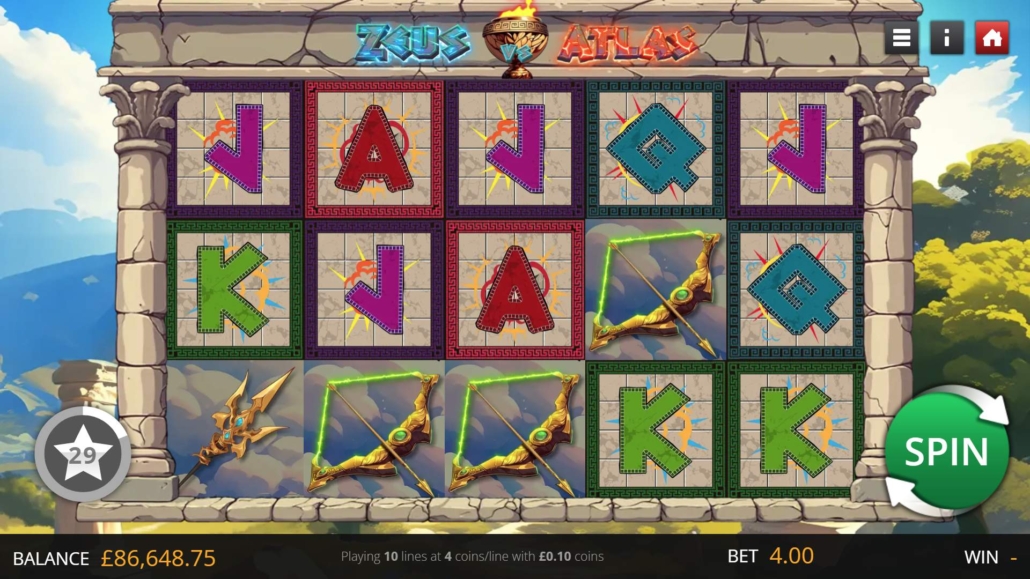
Zeus vs Atlas is a 5×3 video slot utilizing a 25-line paytable. From a structural standpoint, the game is built around the concept of "Dual-Path Volatility." By offering players a choice between two different Feature Games, the developers have introduced a psychological and strategic layer rarely seen in standard RNG (Random Number Generator) titles. The game is designed for high-impact sessions, where the objective is to trigger the high-multiplier Feature Games to capitalize on the 12,875x coin ceiling.

Mechanical Deep-Dive: Feature Analysis
To master Zeus vs Atlas, one must understand the interplay between its three core mechanical pillars.
1. The Random Wild & Roaming Wild Cycle
The game utilizes two distinct Wild mechanics to manipulate the RTP (Return to Player) during peak moments:
- The Random Wild (Bison Stampede Style): This acts as a sudden volatility spike, turning symbols wild to bridge gaps in paylines.
- The Roaming Wild (Free Spins): During the Free Spins phase, the Wild symbol gains "mobility." By moving to a random position on each spin, it prevents "pattern fatigue" and forces the player to account for shifting win probabilities on every rotation.
2. The Choice-Based Feature Game (The "Hold" Mechanic)
The most significant mathematical feature is the Feature Game, triggered by 3+ Scatters. This is a "Hold-and-Win" style mechanic where:
- Symbol Retention: Only Feature symbols remain on the reels.
- Spin Extension: The inclusion of "Extra Spins" symbols allows for extended sessions within the feature, increasing the probability of a full board.
- Payoff Structure: This is where the "Superspins" occur. The payout is directly proportional to the total bet, making it the primary target for high-limit players.
3. The Dual-Path Advantage
Unlike traditional slots where the bonus is a fixed sequence, Zeus vs Atlas provides a choice. This allows players to potentially tilt their experience toward different volatility profiles, although the core objective remains the same: maximizing the prize values revealed at the end of the feature.
The Mathematical Engine: Symbol Values
The symbol hierarchy is strictly tiered to reward long-term play:
- Tier 1 (Jackpot/High Value): Zeus and Atlas. These are the catalysts for the "Superspins."
- Tier 2 (High Value): The mythological artifacts (Prometheus’s Fire, Poseidon’s Trident, etc.).
- Tier 3 (Medium Value): The Greek alphabet (A, K, Q, J).
- The Wild/Scatter: These act as the multipliers and entry keys to the high-yield math models.

Statistical Breakdown
| Parameter | Value |
|---|---|
| Reel Configuration | 5 Reels |
| Paylines | 25 |
| Max Multiplier/Win | 12,875 Coins |
| Feature Trigger | 3+ Feature Scatters |
| Wild Functionality | Substitution + Roaming (Free Spins) |
| Pay Method | Left-to-Right (Scatters: Any Direction) |
Professional Playbook: Optimization Strategies
For the serious player, "playing by feel" is insufficient. Consider these technical approaches:
- Volatility Management: Given the high-volatility nature of the Roaming Wilds and the Feature Games, ensure your bankroll can sustain a "dry spell" between feature triggers.
- The Bet-to-Jackpot Correlation: Since Feature Game prizes are proportional to your total bet, the "Value per Spin" increases significantly at higher stakes. If your goal is the Jackpot, higher-tier betting is mathematically more efficient for maximizing the payout ceiling.
- Feature Targeting: Prioritize the pursuit of the Scatter symbols. The standard line wins are secondary to the mathematical advantage provided by the Feature Games.

Investor FAQ
Q: What is the primary win driver in this game?
A: The primary driver is the Feature Game, specifically the "Hold" mechanic where feature symbols reveal cash prizes and Jackpots.
Q: How does the Roaming Wild affect the math?
A: It introduces a dynamic variable to the Free Spins round, ensuring that the Wild's presence is not predictable, which maintains the high-volatility profile.
Q: Are Scatter wins included in the payline totals?
A: Yes, Scatter wins are paid in addition to any active payline wins, providing a dual-income stream during a single spin.
Q: Can the Feature Game be triggered during Free Spins?
A: No. The game separates the Free Spins mechanic from the Feature Game mechanic to manage the volatility levels effectively.
Q: What is the maximum payout potential?
A: The maximum payout is capped at 12,875 coins.
Executive Summary
Zeus vs Atlas is a sophisticated, high-volatility video slot that rewards players who understand its complex feature set. With its dual-path feature games, roaming wild mechanics, and a high win ceiling, it represents a premium gaming experience for those looking to engage with modern, high-tier slot mathematics.
Analyze the odds, manage your stake, and prepare for a clash of titans. Enter the arena now.